Old City Cemetery Secrets Being Unearthed

These are the same tombstones for Charley Minix. Due to the amount of dirt and grime that had built up, the years he lived were thought to be 1802 – 1808. Since it’s been cleaned however, the exact dates still could be 1802 – 1802. What is casting doubt on that are the dates of the headstones next to him. What can be clearly read though is the epitaph that was written: “Sleep On, Sweet Babe, and Take Thy Rest. God Called Thee Home. He Thought It Best.” (Photos by Holly Wood and Chris Cole).
By Chris Cole,
Staff Writer
Last week, Billy Wilkerson and Ashley Sutherland of the Simpson County Historical Society brought their Ground Penetrating Radar (GPR) unit to Scottsville’s Old City Cemetery. Located behind the Allen County Courthouse, it has long been suspected that more than a few “lost” graves existed. What was unknown was to what extent.
The City of Scottsville Preservation Commission, in conjunction with the Allen County Genealogical Museum and Historical Society, reached out to Wilkerson to bring his GPR equipment–along with the divining rods that ended up being a big hit every time they’d get a hit–to either confirm or deny what was long suspected.
What’s been discovered, however, likely wasn’t what anyone involved with this project anticipated.
For starters, it was reported last week that two mass graves had been found. One measured 83 feet long while the other measured 17 feet long. The likely cause was an epidemic with the possibilities being cholera, tuberculosis, Scarlet fever or even the Spanish Flu in the wake of World War I.
Since then, Wilkerson and another assistant, Scarlett Davenport, made a return. On Friday, June 20, they came back to Scottsville to hopefully complete their work. Originally, they were scheduled to come back on Monday. However, heavy moisture in the ground tends to give off false readings for GPR and the rain on Monday might it impossible to do any further work in the Old City Cemetery.
That didn’t stop Wilkerson from giving an update on his work to the Historical Society in Scottsville that evening. Members remarked that “it was the most interest we’ve had maybe ever” as Wilkerson went through the process on how GPR works and what the initial results were.
As of Monday, June 16, at least one-hundred seventy previously unmarked graves had been found along with the two mass graves. He went into how an approximate date could be determined through how the soil was layered and if a coffin was present (from the early twentieth century after) or it had disintegrated (up until the early twentieth century).
The biggest news came though when he said that he’s as certain as he can be based on other known sites that an ancient people we refer to as the Mississippians (due to them largely settling in the watershed of the Mississippi River and its various tributaries, particularly the Ohio River and Tennessee River) very likely have a burial site within the confines of the Old City Cemetery. They are part of what is collectively known as “Mound-Builders” and are not genetically linked with other native tribes as far as scientific research has concluded. Little is actually known about them, yet what is known is extremely fascinating.
Due to the strong evidence that the Old City Cemetery contains such a burial spot, Wilkerson (with the support of the Preservation Commission and Historical Society) decided to not include the Global Positioning Satellite (GPS) coordinates for that mound. However, other located burial sites will have their matching coordinates given so that anyone who is outside the area can bring them up on service such as Google Earth and see them.
It was also reported last week that the oldest marked grave in the Old City Cemetery was that of an eight year old boy named Charley Minix. Cleaning his headstone and the headstones next to his has now cast some doubt on that.
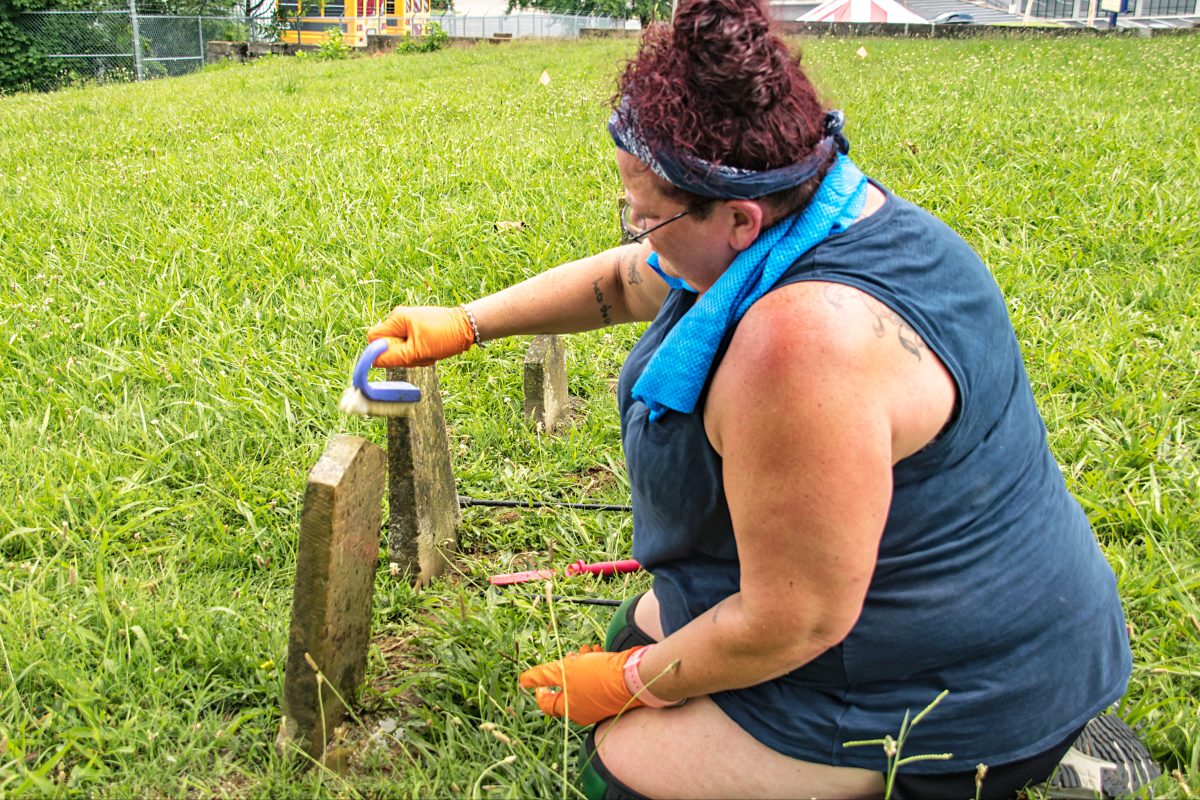
Scarlett Davenport joined Billy Wilkerson on Friday, June 20 at the Old City Cemetery. She took on the task of cleaning headstones. (Photo by Chris Cole).
Holly Wood did some extensive cleaning of Charley’s tombstone and the one next to his. She believes they may be his parents, William Minix (Lafayette, Tenn. July 25, 1844, Scottsville, Ky. August 24, 1919) and William’s second wife Martha Tennessee Davidson Minix (Lafayette, Tenn. September 24, 1870, Scottsville, Ky. January 29, 1949). It should be noted that Martha Davidson Minix is buried in Crescent Hill Cemetery while William is in the Old City Cemetery.
What made Wood suspicious of the date for Charley Minix was that, when she cleaned his tombstone, there was an inscription that reads “Son of Martha T. Minix,” meaning that the dates of 1802-1808 wouldn’t make much sense. It’s likely that, with a bit more cleaning, the ‘0’ will turn into a ‘9’, making the dates 1892-1898.
The cleaning of his headstone did reveal something special, however. “Sleep on, sweet babe, and take thy rest. God called thee home. He thought it best.”
Scarlett Davenport, who was there on Friday assisting Wilkerson, took the task of further cleaning some of the older headstones. “It’s like finding people that were lost,” she said as she took a solution that “the longer it sits the better they (the headstones) start looking.”
The headstones she was working on was for an infant named William Heeter who was born May 15, 1856 and died in October 1856. “He probably doesn’t have any family left,” said Davenport.
Most of the rest of the day was confirming research that Wood and many others, such as former city planner Gary Mathis, had done.
“He’s one who actually did a lot of research and did this map,” said Wood. “Then these are the printouts of the burial plots with the names that were known that he could find.”
What was shown on the map were a lot of marks but then it was noticed that there were areas where some gaps appeared to be. As it turned out, those were areas where the mass graves had been found.
“The map that the Historical Society was able to give us at the cemetery, then Billy’s readings, it makes sense why we would have huge gaps with no markings of graves or monuments,” said Wood.
It was also discovered while going through old census records and city records that a pattern was developing – if families were neighbors in life, they were going to be neighbors in death too. Wood stated that many families who lived close to one another were also buried in fairly close proximity to one another.
While all of this was being revealed, Wilkerson potentially made another big discovery – another mass grave.
“There’s still more research we need to do,” said Wilkerson as this one appeared to be larger than the 83 foot long one.
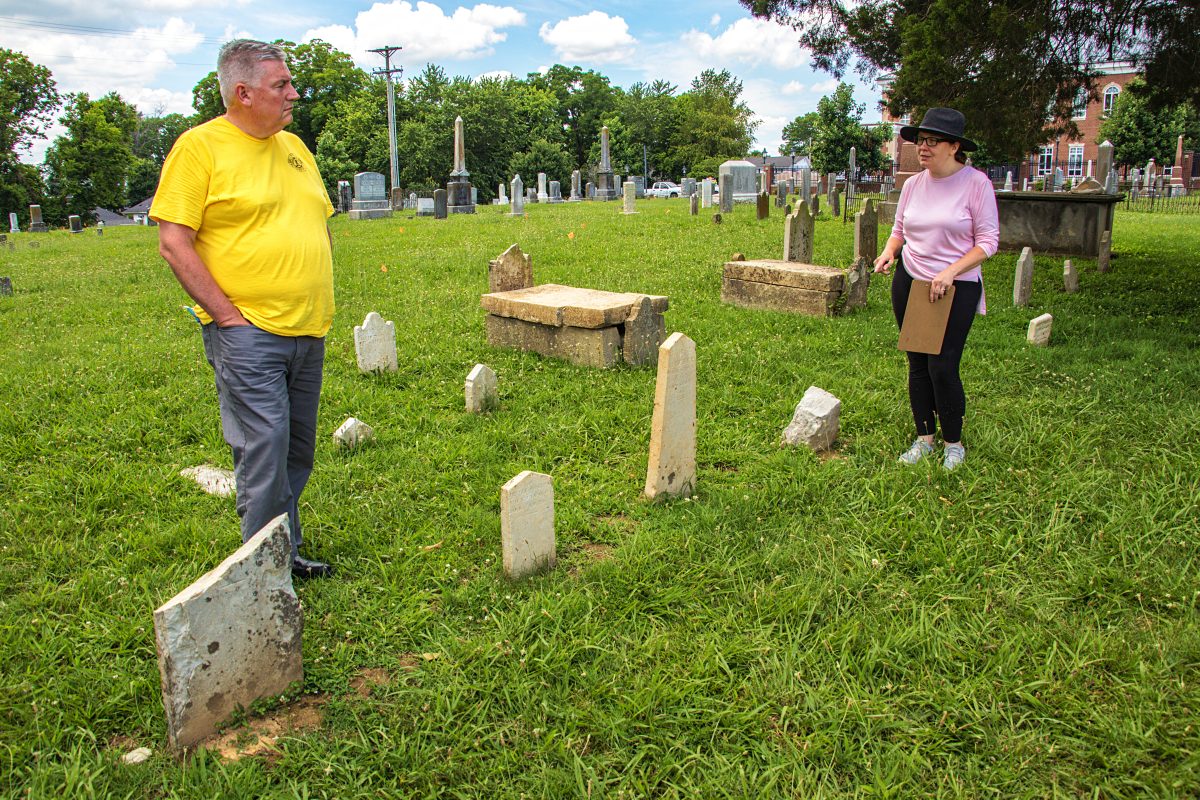
Scott Dobler, Geographic Information Systems Analyst for the city of Scottsville, had been given a special task along with Jada Barnett (not pictured) to document the graves of veterans in the Old City Cemetery. Some of the work he was doing was coinciding with the work Holly Wood and the City of Scottsville Preservation Commission were doing. Here they are comparing notes. (Photo by Chris Cole).
At first, Wilkerson was very hesitant to even say that much. Yet there was a larger crowd of people gathered than when he and Sutherland were there last week and instead of circulating rumors, he wanted to make sure that the public understands, “We don’t know if it’s from one of the epidemics. We don’t know if it’s a possible mass Indian burial ground. We just don’t know details yet. It’s just hard to say. We can speculate and say what it is, which is right now…it is a mass burial.”
While being able to give a solid potential time frame for much smaller unmarked and previously lost graves can be done with some degree of accuracy, for mass graves it’s nearly impossible.
“There’s no way to date the grave. There’s no way we’re going to be able to do that. It is more or less you know, (you’d have to) excavate and bring one of them up. That is absolutely the last thing that we want to do. Because we don’t want to disturb the graves. We’re just here to find missing graves that were unmarked, or once was marked and the markers are going to have deteriorated. Then, you know, bringing the light to these mass graves. We’re going to do more research and I want to compile the data. Then soon as I can get that together then I’ll get back with you,” said Wilkerson.
If these finds weren’t interesting enough, a reminder of our nation’s past might also have made itself known.
In the most western facing section of the Old City Cemetery, a large number of unmarked graves were discovered. It is quite likely there may be many more. What makes that interesting is that it was in these sections the slaves were often buried. However, there is evidence at another Allen County cemetery that a slave was buried with the family.
Still, the possibility of those who are buried in the western section created a moment where all who were gathered recognized that human life, human death and human burial is sacred while wishing that attitude had been shared during their life.
With all the discoveries coming in, along with the speculation and the research, Scott Dobler and Jada Barnett, both who work for the City of Scottsville utilities, were given a side project to locate veteran graves. That turned into yet another project.
“We decided that the entire cemetery needed to be mapped. So we flew a drone over the cemetery and mapped all the headstones. Then Jada took that data and continued developing it,” said Dobler.
Barnett then said, “Taking that imagery from the drone flights that we collected, I was able to plot the points for each of the visible headstones. So now we’re at the point where we have those points in a database. We just need to plug in the information for it. We’re digging through, we’re coming out here taking photos and eventually we will have a database where people can view that on a website and potentially be able to route to a loved one and be able to you know exactly where they are and get walking directions to the site.”
Being able to get the precise GPS coordinates from Wilkerson will certainly help in this regard.
“I think it’s a fascinating link to history,” added Dobler. “We are currently in a transition time where people don’t bury like they used to. So we had about one-hundred years here or two-hundred years where people were very specific on how and the procedure that their family did for burying.”
Through this combined research, it was also discovered that while not every grave has a marker, not every marker actually has a body underneath it.
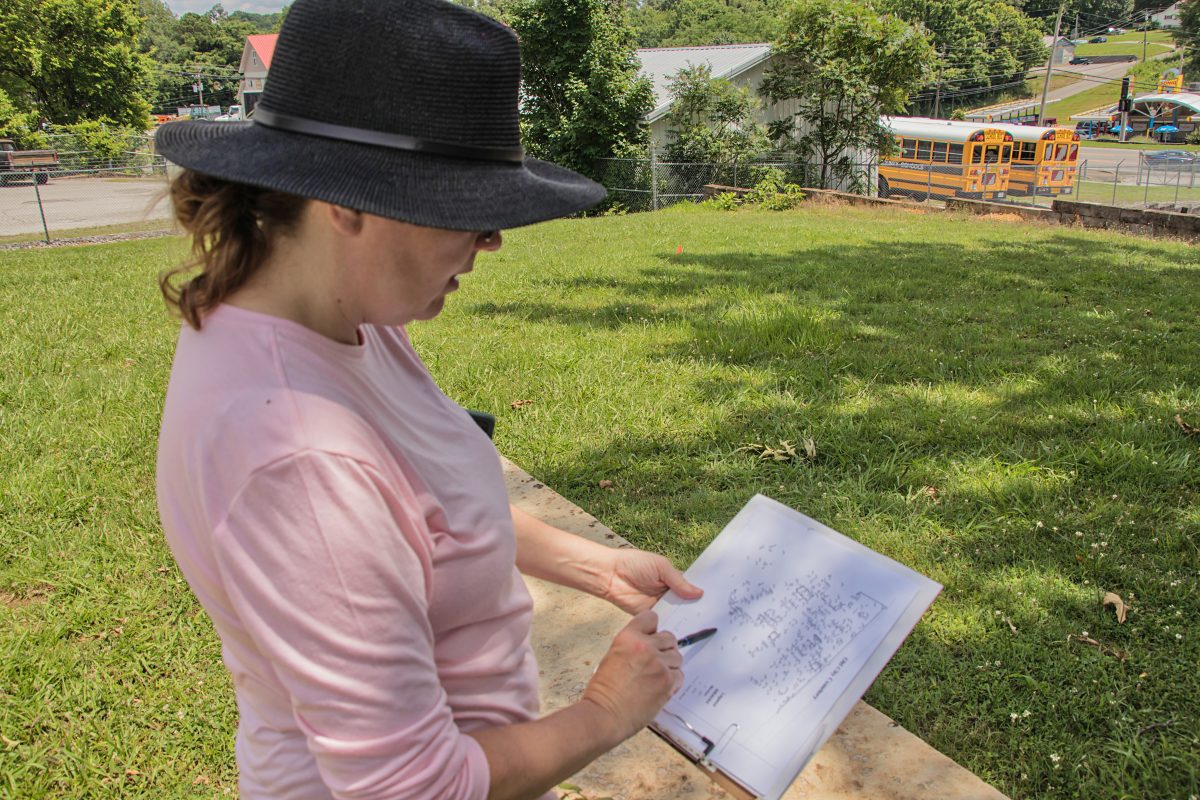
Holly Wood is comparing a map of the Old City Cemetery, compiled by former Scottsville City Planner Gary Mathis, to what Billy Wilkerson was finding with GPR. While generally accurate, the GPR is in many ways “filling in gaps” that weren’t noted on the map. (Photo by Chris Cole).
“Holly Wood’s telling me that there are some people that put stones down here in memoriam. So the person’s not actually buried here. They are memorialized in this cemetery, which is fascinating how different people over time look at celebrating life and life after death,” said Dobler.
The work is certainly far from being over, with Wood stating, “We could spend years and probably never even know everything.” Even in the short amount of time that this specific work has been going on, there has been a massive amount of speculation and brainstorming out loud.
Wilkerson and his team will be returning at least once more to the Old City Cemetery where he’ll gather his last bit of raw data. That will be on the Tuesday of this week’s edition. Any updates will have to be printed in the following week’s edition.
He also plans on appearing at another upcoming meeting of the Historical Society, hopefully with some more definitive answers than in his previous meeting. Plus, Wilkerson will be part of this year’s Grave Line Tour in which he will share any updates that have been discovered.
In the meantime, the City of Scottsville Preservation Commission, along with the Allen County Genealogical Museum and Historical Society want to make it very well known that any unauthorized digging taking place within the Old City Cemetery, or even transient activity, is strictly forbidden. That’s why professionals with GPR have been called in so that this work can be done without disturbing any of the graves that exist.
Also, according to Kentucky Revised Statute 381.697 paragraph 2, “The owner or owners of public or private burial grounds, regardless of size or number of graves, shall protect the burial grounds from desecration or destruction as stipulated in KRS 525.115(1)(a), (b), or (c) or from being used for dumping grounds, building sites, or any other use which may result in the burial grounds being damaged or destroyed. The provisions of this subsection shall not apply to the owner or owners of public or private burial grounds when the public or private burial grounds have been desecrated, damaged, or destroyed as the result of a crime by another as defined by KRS 500.080.”
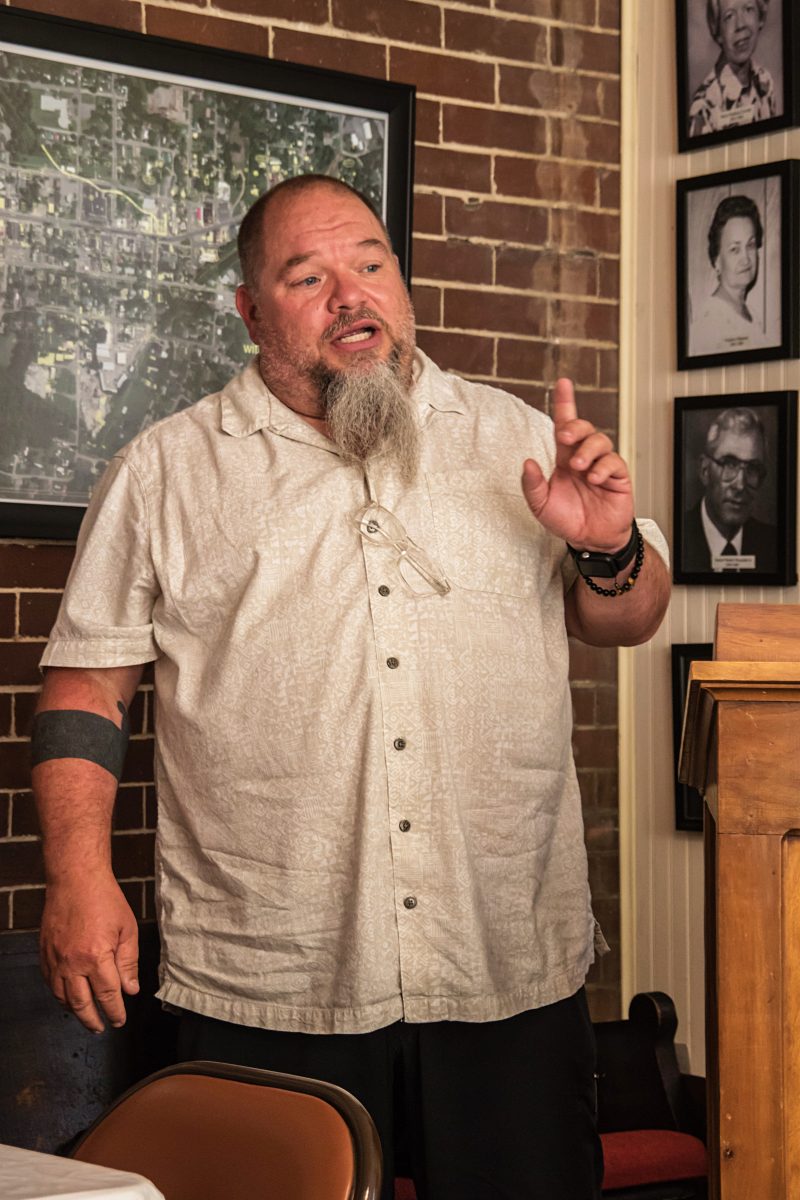
Billy Wilkerson of the Simpson County Historical Society was unable to complete his work on Monday, June 16 at the Old City Cemetery. That didn’t stop him from giving an update to the Historical Society in Scottsville however. (Photo by Chris Cole).